
Judge C.R. Magney State Park
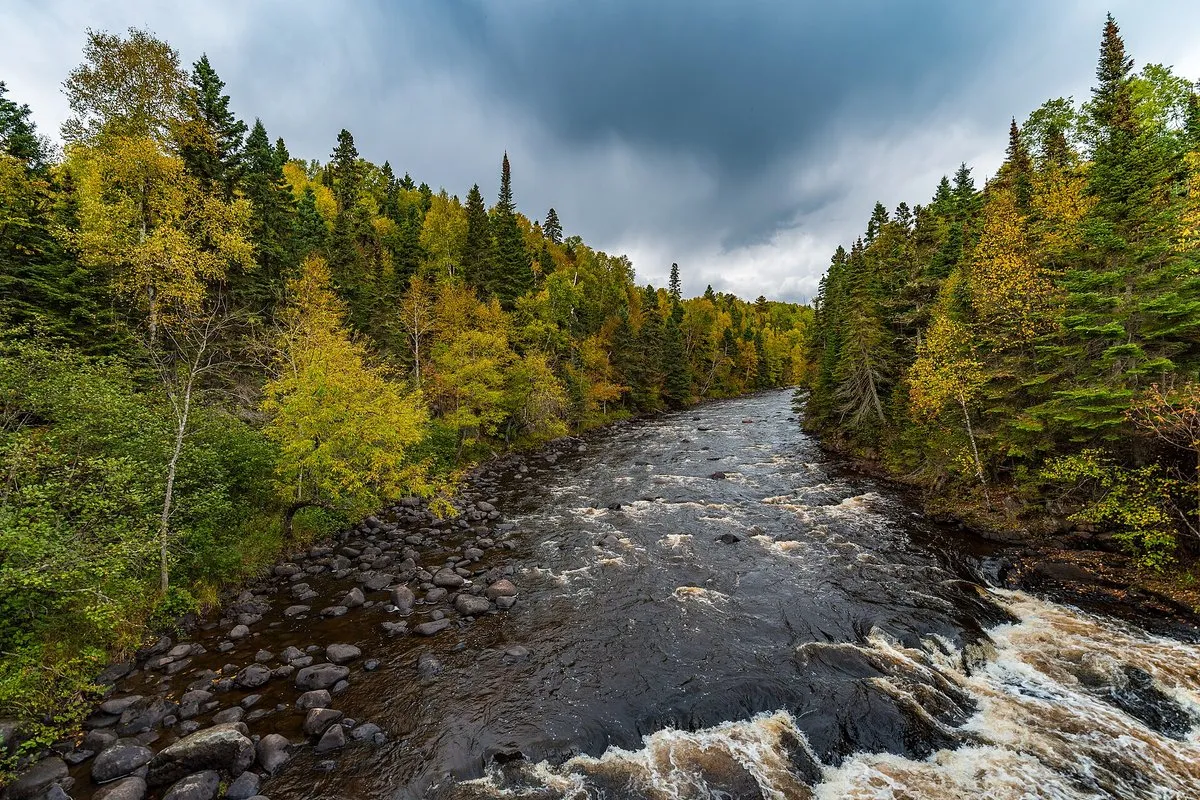
Tucked along the northeastern edge of Minnesota’s North Shore, Judge C.R. Magney State Park sits on the rugged shore of Lake Superior near the Canadian border, roughly 14 miles northeast of Grand Marais. The park follows the Brule River as it cuts through dense boreal forest before emptying into the lake, and it draws visitors from across the region for one reason above all others: a waterfall where part of the Brule River drops into a pothole and is understood to rejoin the river downstream, based on Minnesota DNR streamflow measurements.
Devil’s Kettle: The Park’s Famous Mystery
The centerpiece of this park is Devil’s Kettle, a split waterfall on the Brule River where the water divides around a rock outcropping. The eastern half cascades down a conventional lower falls. The western half drops into a deep pothole; Minnesota DNR hydrologists found the water resurges in the Brule River below the falls. Earlier attempts with floating objects reportedly did not reveal an outlet, but Minnesota DNR streamflow measurements later showed no meaningful water loss and confirmed the water resurges in the river below the falls. The geology of the area, largely composed of ancient rhyolite, offers some theoretical explanations involving underground drainage, but the water-flow mystery is now understood: DNR measurements indicate the water resurges in the Brule River below the falls, though the exact small-scale subsurface path is not visually obvious.
Reaching Devil’s Kettle requires a moderately strenuous hike of about 1 mile one way from the parking area, gaining significant elevation as the trail climbs above the river gorge. The path crosses the river and passes Upper Falls along the way, offering a preview of the landscape before the main event. The terrain is rocky and rooted, and footing can be slippery near the water, so sturdy footwear is strongly recommended. Plan to spend about 1.5 to 2 hours on the hike.
Hiking the Brule River Corridor
Beyond Devil’s Kettle, the park offers roughly 9 miles of hiking trails that wind through old-growth forest, along the Brule River, and out to Lake Superior overlooks. The terrain throughout is characteristic of the North Shore, meaning steep, rocky, and physically demanding in places. Hikers should come prepared for uneven ground and limited shade in exposed ridge sections.
The Brule River itself is the defining geographic feature of the trail system. The river runs fast and cold, and in early spring or after heavy rain it becomes genuinely powerful. Staying on marked trails and keeping distance from the riverbanks is important, particularly with children. The park has at least one easy loop option, the mostly flat 1-mile Timberdoodle Trail; other routes may require out-and-back hiking, so plan your turnaround time accordingly.
Fishing is permitted in the Brule River and draws anglers targeting steelhead and coho salmon during their seasonal runs, though fishing is secondary to hiking as a visitor activity here.
Camping in the Boreal Forest
The campground at Judge C.R. Magney is small and quiet, with 27 drive-in campsites available. Sites are set within thick forest cover and offer a genuine sense of seclusion compared to larger state park campgrounds. Facilities include seasonal restroom and shower facilities, toilets, drinking water, dumpster and recycling, but there are no electrical hookups. The campground suits tent campers and smaller camping rigs well, though larger RVs may find the site layout limiting.
Because the park sits in prime black bear and wolf territory, proper food storage is not optional. Store food, coolers, and scented items in a hard-sided vehicle or bear-resistant container, and keep all scented items secured at night.
Pet Policy
Pets are welcome in the park but must be kept on a leash no longer than 6 feet at all times. They are allowed on most trails and in the campground. Pets are not permitted in park buildings or beach areas; only service animals are allowed in those areas. Given the wildlife in and around the park, keeping animals close and controlled is genuinely important rather than just a formality.
Wildlife to Be Aware Of
Black bears are common throughout the park and the surrounding forest. They are attracted to food smells at campsites and along trails. Store all food in bear-resistant containers or locked vehicles, never in tents, and clean up camp thoroughly after cooking. If you encounter a bear on the trail, back away calmly, speak in a firm voice, and give it space to leave.
Gray wolves inhabit the broader North Shore forest and are occasionally seen or heard near the park. Wolf encounters with people are rare, but if one approaches closely, stand tall, make noise, and do not run. Keep children and pets close in forested areas, particularly at dawn and dusk.
Moose are active in the park, especially near the Brule River corridor where they come to feed and drink. Moose are large, unpredictable, and potentially dangerous, particularly cows with calves in spring and bulls during the fall rut. Give any moose you encounter a wide berth and retreat if it shows signs of agitation such as raised hackles, lowered head, or pinned ears.
Canada lynx inhabit parts of northeastern Minnesota, but sightings in the park are uncommon and should not be stated as park-confirmed unless sourced. Lynx pose little threat to adult humans but should not be approached or fed.
Practical Information
Judge C.R. Magney State Park is located at 4051 East Highway 61, Grand Marais, MN 55604, accessible via Highway 61 along the North Shore. Grand Marais is the nearest full-service town, approximately 14 miles to the southwest. The park is open year-round, though winter conditions can make trails icy and some facilities are closed outside the main season. Campsite reservations can be made through the Minnesota DNR reservation system at mndnr.gov/reservations and are recommended for summer weekends.
Entry requires a vehicle permit. The daily fee is $7 per vehicle. An annual Minnesota state park pass is also available and covers the entry fee at all state parks throughout the year.
Frequently Asked Questions
What is the entry fee for Judge C.R. Magney State Park?
Entry requires a vehicle permit with a daily fee of $7 per vehicle. An annual Minnesota state park pass is also available and covers the entry fee at all state parks throughout the year.
Are dogs allowed at Judge C.R. Magney State Park?
Pets are welcome in the park and are allowed on most trails and in the campground, but must be kept on a leash no longer than 6 feet at all times. Pets are not permitted in the park's swim area or inside any park buildings.
How hard is the hike to Devil's Kettle?
The hike to Devil's Kettle is moderately strenuous at about 2.3 miles one way from the parking area, gaining significant elevation as the trail climbs above the river gorge. The terrain is rocky and rooted, and the round trip takes most visitors between two and three hours.
Does the campground at Judge C.R. Magney State Park have electrical hookups?
The campground has 27 drive-in sites and 4 walk-in sites with facilities that include flush toilets and a dump station, but there are no electrical hookups. The campground suits tent campers and smaller camping rigs well, though larger RVs may find the site layout limiting.