
Tahquamenon Falls State Park
Tahquamenon Falls State Park protects one of the most powerful waterfalls east of the Mississippi, drawing visitors to Michigan’s eastern Upper Peninsula year after year. Located near the small town of Paradise, the park covers nearly 50,000 acres of northern forest along the Tahquamenon River. The dark, tea-colored water, stained by tannins from surrounding cedar and spruce wetlands, gives the falls their distinctive amber appearance and sets this park apart from any other waterfall destination in the Midwest.
The Upper and Lower Falls
The Upper Falls is the centerpiece of the park and one of the largest waterfalls in the eastern United States. It spans roughly 200 feet wide and drops nearly 50 feet, with a flow that can reach 50,000 gallons per second during peak runoff. A short paved trail leads from the main parking area to several overlooks, and a new 1,100-foot fully accessible boardwalk now provides close-up views of the cascade. The experience is dramatic at every season, from the full surge of spring snowmelt to the ice formations that frame the falls in winter.
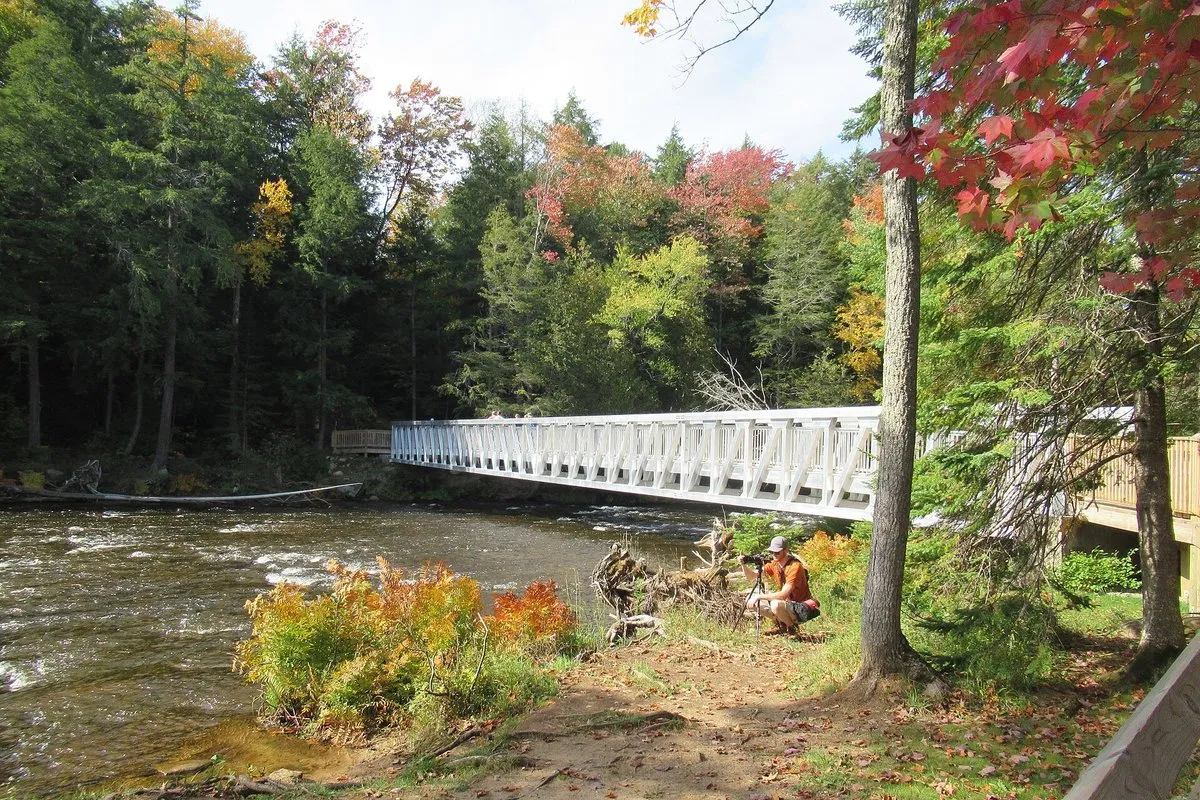
The Lower Falls, about four miles downstream by trail or road, is a different experience entirely. Rather than a single dramatic drop, the Lower Falls consists of a series of cascades wrapping around a small island. Visitors can cross the Ronald A. Olson Island Bridge or rent rowboats from a concession to reach the island and walk among the falls from the middle of the river. This is one of the more unusual and hands-on ways to experience a waterfall anywhere in the region.
Forest Trails and River Corridor
The park maintains more than 35 miles of trails ranging from short paved accessible paths to multi-day backcountry routes. The North Country Trail passes through the park, connecting the Upper and Lower Falls along the river’s south bank through dense stands of hemlock, maple, and yellow birch. This stretch is particularly striking in early October when fall color peaks. Birders find the river corridor productive, with species like osprey, common merganser, and occasionally bald eagles visible along the water.
Paddlers can explore the 17-mile stretch of Tahquamenon River from the Lower Falls to the Rivermouth area, with carry-in access at the Lower Falls day-use area and at Rivermouth Modern Campground. The current is generally manageable for both experienced canoeists and casual paddlers, but anyone planning the trip should study the route carefully and stay well clear of waterfall areas.
Camping
The park offers several campgrounds and backcountry campsites with nearly 300 regular sites, covering a range of options from modern electric RV and tent sites to rustic sites and hike-in backcountry sites. Rivermouth Modern and Rivermouth Rustic campgrounds near Paradise sit close to the point where the Tahquamenon empties into Lake Superior’s Whitefish Bay, giving campers access to the river mouth and nearby shoreline in addition to the forest. Tahquamenon Falls Lower Falls Modern Campground is closer to the falls themselves and is the more popular choice for visitors focused on the waterfall trails.
The park is open year-round, and winter camping has a following among snowshoers and cross-country skiers who use the trail system when it is snow-covered. Reservations are strongly recommended from late spring through Labor Day weekend, and particularly on summer weekends when the park sees its heaviest use.
Pet Policy
Pets are welcome at Tahquamenon Falls State Park and must be kept on a leash no longer than six feet at all times. Pets are allowed on trails, including viewing platforms, and in campgrounds. They are not permitted inside any park buildings or in designated swimming areas. Owners are responsible for cleaning up after their pets throughout the park.
Wildlife to Be Aware Of
The Upper Peninsula forest that surrounds this park supports a healthy black bear population, and bears are regularly active near campgrounds and trailheads. Store all food, coolers, scented toiletries, and garbage in a hard-sided vehicle or bear box, never in a tent. If you encounter a bear on the trail, give it space and do not run.
Michigan’s only venomous snake is the eastern massasauga rattlesnake, a species found in the Lower Peninsula and not on the Upper Peninsula mainland. Nonvenomous snakes may still be encountered in warm, sunny areas, so watch where you place your hands and feet when scrambling near rocky outcrops, and stay on established trails when possible.
Blacklegged ticks, also known as deer ticks, are common on wooded trails throughout the region. These ticks can carry Lyme disease, and the risk is present from spring through late fall. Wear long pants and light-colored clothing, apply insect repellent, and do thorough tick checks after any time in the woods. Remove any attached ticks promptly with fine-tipped tweezers.
Biting insects are a real seasonal factor along the river corridor and in wetland areas. Mosquitoes are heaviest in late spring and early summer, and black flies can be intense from May through June. Bring head nets and strong repellent if you are visiting during these months, especially for dawn and dusk hiking.
Practical Information
Tahquamenon Falls State Park is located at approximately 46.6107 N, 85.2063 W, near Paradise, mostly in Chippewa County with western portions in Luce County. The main entrance to the Upper Falls is reached via M-123, which connects to Paradise to the north and to Newberry to the south. Paradise is the closest town with gas, groceries, and lodging options.
Vehicle entry requires a Michigan Recreation Passport. Resident vehicle passes cost $15 when purchased with Michigan license plate renewal, with a $5 convenience fee if purchased later. Nonresident annual passes cost $42, and nonresident daily passes cost $12. Resident passes must be purchased at the time of plate renewal or at a state park entrance, while nonresident annual passes can be purchased online or at any state park. Walk-in and bicycle access is free. Reservations for camping can be made through the Michigan DNR reservation system and are highly recommended for summer and fall color season visits.
Frequently Asked Questions
Is a Recreation Passport required to enter Tahquamenon Falls State Park?
Entry requires a Michigan Recreation Passport for motorized vehicles. Resident passes cost $15 at license plate renewal (plus a $5 convenience fee if purchased later); nonresident passes are $42 annual or $12 daily. Walk-in and bicycle access is free.
Can I bring my dog to Tahquamenon Falls State Park?
Leashed dogs are welcome on trails including viewing platforms and in campgrounds, but are not permitted inside park buildings or in designated swimming areas.
Do I need reservations for camping at Tahquamenon Falls State Park?
Reservations are strongly recommended from late spring through Labor Day weekend, especially on summer weekends when the campgrounds are in high demand. The park offers nearly 300 sites ranging from modern electric RV and tent sites to rustic and hike-in backcountry options.
Can I get close to the Upper Falls, and is there accessible viewing?
Several overlooks are accessible via a short paved trail from the main parking area, and a new 1,100-foot fully accessible boardwalk now provides close-up views of the Upper Falls cascade.