
Hartwick Pines State Park
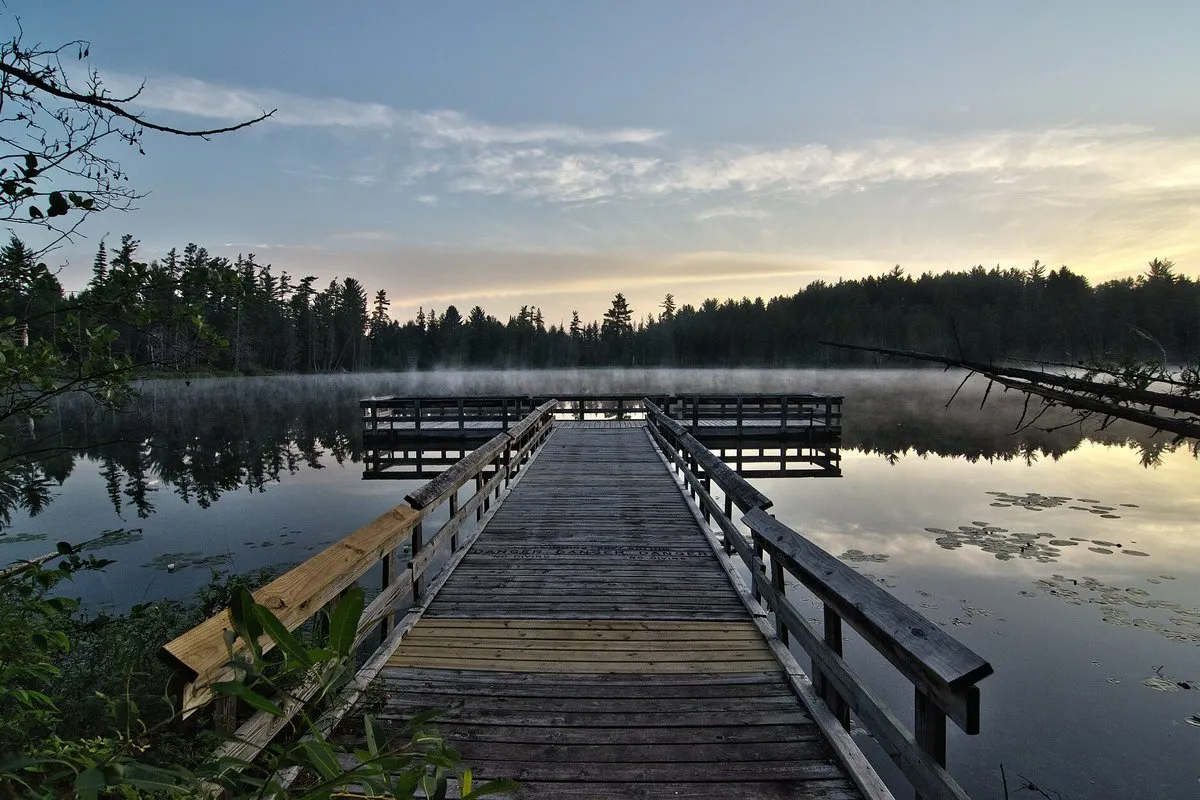
Hartwick Pines State Park stands in the northern Lower Peninsula of Michigan, about five miles northeast of Grayling, preserving one of the last significant stands of old-growth white pine in the Great Lakes region. At 9,335 acres, it protects a forest that once covered millions of acres across Michigan before the logging industry cleared nearly all of it in the late 1800s. The 49-acre Virgin Pines tract at the heart of the park contains trees more than 300 years old, some rising over 100 feet tall, giving visitors a rare and immediate sense of what the pre-settlement Michigan forest actually looked like.
The Old-Growth Forest and Virgin Pines
The Virgin Pines area is the reason most people make the trip to Hartwick Pines, and it lives up to the expectation. A short loop trail winds through the old-growth stand, where the scale of the trees, the cathedral-like spacing, and the near-silence overhead set this section apart from any second-growth forest in the state. The understory is open and cathedral in quality, with soft light filtering through the canopy and a thick duff of pine needles underfoot.
The main forest trail system extends well beyond the old-growth tract. Approximately 21 miles of trails cross the park, ranging from easy, paved accessible paths near the interpretive center to longer loops through younger mixed forest. The 1.25-mile paved Old Growth Forest Trail through the Virgin Pines includes two steep grades but allows visitors who cannot manage rougher terrain to still reach the largest and oldest trees in the park.
Michigan Forest Visitor Center and Logging Museum
Adjacent to the trail system, the Michigan Forest Visitor Center is one of the better interpretive facilities in the state park system. Exhibits trace the full arc of Michigan’s white pine logging era, from the peak harvest years of the 1870s and 1880s through the near-complete deforestation that followed. The displays explain how the industry operated, the tools and camps involved, and the ecological and economic consequences that reshaped the entire region.
Outside, a reconstructed logging camp brings that period further into focus. The camp includes a bunkhouse, blacksmith shop, and heavy equipment from the era, all positioned in a forest clearing that adds genuine atmosphere. Interpretive signs throughout the outdoor exhibits fill in the operational details of how a 19th-century logging camp was organized and run. This combination of indoor exhibits and outdoor reconstruction makes the history accessible and specific rather than abstract.
Camping at Hartwick Pines
The park has a large modern campground with 100 sites, all offering 20/30 amp electrical service, with sites 65 through 100 providing full hookups with 50 amp service. The campground serves as a reasonable base for exploring the park across multiple days, and its location in northern Michigan puts it within reach of Au Sable River canoeing, elk viewing routes, and other regional attractions. Sites can fill quickly during summer weekends and fall color season, so advance reservations are strongly recommended.
A rustic cabin option is also available for those who want a roof without bringing their own gear. The cabin is basic but functional, sleeping up to seven, with propane heat, no electricity, and nearby rustic facilities including a hand pump and vault toilet.
Pet Policy
Leashed pets are welcome throughout most of the park, including on trails and in the campground. The leash length must not exceed six feet. Pets are not permitted inside the Michigan Forest Visitor Center or in the reconstructed logging camp buildings. Owners are responsible for cleaning up after their animals and keeping them from disturbing wildlife or other visitors.
Wildlife to Be Aware Of
Black bears live in the forests of northern Michigan and are present in and around Hartwick Pines. Near campgrounds, they are most likely to be attracted by food and scented items left unsecured. Store food in hard-sided containers or your vehicle, keep a clean campsite, and never leave coolers or cooking gear unattended. If you encounter a bear on a trail, give it space and back away calmly without running.
White-tailed deer are abundant throughout the park and are frequently seen on trails and near roadsides, particularly at dawn and dusk. They are not aggressive under normal circumstances, but their unpredictable movement across roads creates a real driving hazard, especially on the approach roads during low light hours. Slow down when driving through forested stretches.
Ticks, including deer ticks capable of transmitting Lyme disease, are present throughout the park in wooded areas and tall grass. Wear long sleeves and pants when hiking, use insect repellent containing DEET on skin and clothing, and do a full-body tick check after every outing. Prompt removal within 24 to 36 hours significantly reduces transmission risk.
Coyotes are occasionally seen near campground edges and wooded boundaries, usually at dusk or after dark. They rarely pose a threat to adults but should not be fed or approached. Keep small pets close, particularly in the evening.
Practical Information
Hartwick Pines State Park is located at 3612 State Park Drive, Grayling, Michigan, just northeast of Grayling off M-93. From I-75, take exit 259 and follow the signs to the park entrance. Grayling is the nearest town with full services including fuel, groceries, and lodging.
Vehicle entry requires a Michigan Recreation Passport. The annual resident passport costs $15 when purchased with license plate renewal, or $20 if purchased at a park outside the renewal period. Nonresident passports are $42 annually or $12 daily, with daily permits available for purchase at the park entry.
The Michigan Forest Visitor Center is open daily from May 1 through Labor Day, with weekend hours in early spring and fall and a closure from Nov. 15 through Dec. 31. The Logging Museum is open daily from May 1 through Labor Day and on weekends from after Labor Day through Oct. 31. The trails are generally accessible year-round, subject to temporary closures, and the modern campground is reservable May 1 through Oct. 31, while the rustic cabin is available year-round. A section of the Au Sable River Trail is currently closed indefinitely due to footbridge conditions, though the remainder of the trail is open and requires an out-and-back route to complete. The park draws cross-country skiers in winter when snow conditions allow. Campsite reservations can be made through the Michigan DNR reservation system at midnrreservations.com.
Frequently Asked Questions
Are dogs allowed at Hartwick Pines State Park?
Leashed pets are welcome throughout most of the park, including on trails and in the campground.
How much does it cost to enter Hartwick Pines State Park?
Entry requires a Michigan Recreation Passport, which costs $12 per year for residents and $35 per year for non-residents, with daily permits also available at the park entrance.
Can you walk through the old-growth pine forest at Hartwick Pines?
The 1.25-mile paved Old Growth Forest Trail loops through the Virgin Pines tract, where trees more than 300 years old rise over 100 feet tall, and the paved surface makes the largest trees accessible to visitors who cannot manage rougher terrain.
Do I need to make a reservation to camp at Hartwick Pines?
Advance reservations are strongly recommended because sites fill quickly during summer weekends and fall color season, and the modern campground offers 100 electrical sites including full hookup options with 50 amp service.