
DeSoto State Park
Perched atop Lookout Mountain in northeastern Alabama, DeSoto State Park covers more than 3,500 acres of forested plateau, creek gorges, and rocky bluffs in DeKalb County. The park sits adjacent to Little River Canyon National Preserve, and together the two areas form one of the most scenic stretches of the southern Appalachians. The park is named for Spanish explorer Hernando de Soto; local legend places his expedition in the area in 1541, but most authorities believe the route passed farther south. What sets it apart from most Alabama state parks is the combination of dramatic canyon scenery, an extensive trail network, and overnight accommodations ranging from full-service cabins to tent camping, all within a few hours of Birmingham, Chattanooga, and Atlanta.
DeSoto Falls and Little River Canyon
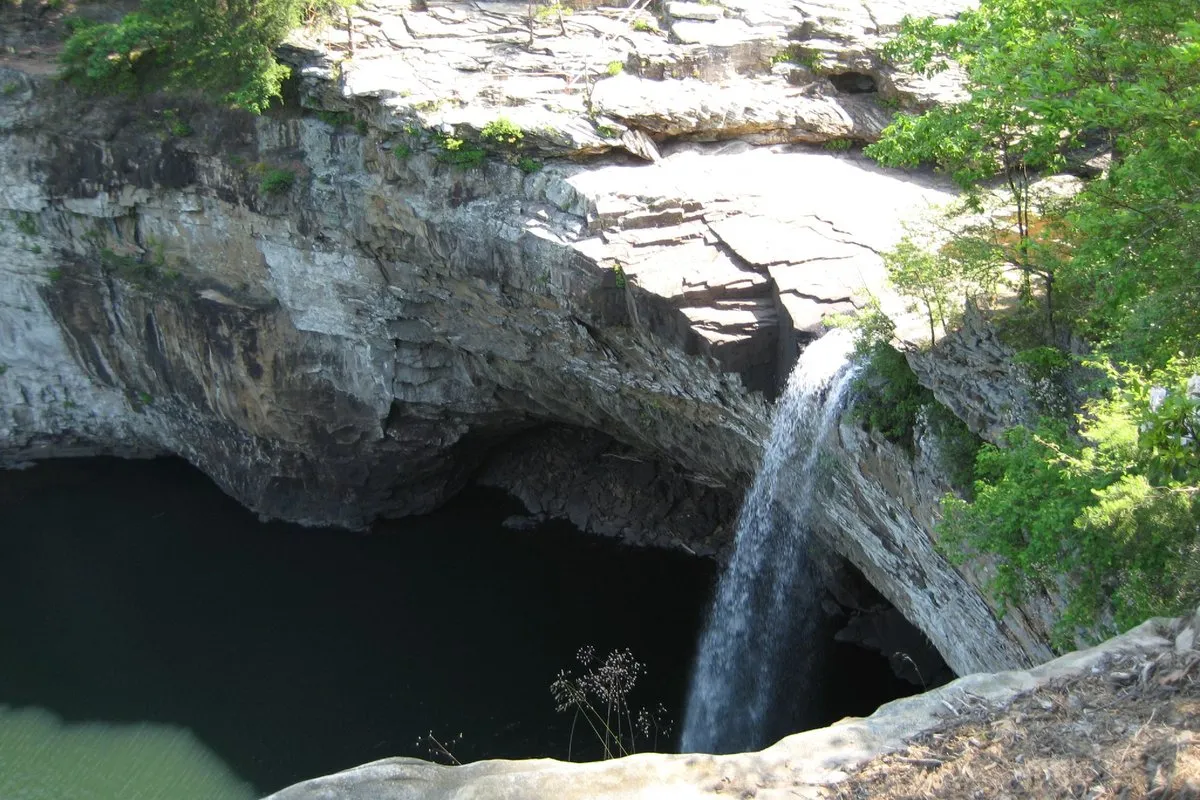
The park’s most recognizable feature is DeSoto Falls, where the West Fork of Little River drops roughly 104 feet over a sandstone ledge into a deep pool. It is one of Alabama’s tallest and most visited waterfalls, and the overlook draws visitors who may not set foot on another trail the entire day. The DeSoto Falls area is a separate picnic area about seven miles from the main park; the main overlook is reached by descending 50 concrete stairs from the parking area. Little River itself is unusual in that it runs for most of its length along the top of a mountain rather than descending into a valley, making the surrounding canyon system one of the more geologically distinctive landscapes in the Southeast. The falls area has its own parking lot and charges a $5 per vehicle parking fee, separate from the rest of the park.
Trails Across the Mountain
With over 30 miles of marked trails, DeSoto has enough variety to keep hikers busy across multiple visits. The terrain shifts between open bluffs with long views, dense hardwood and pine forest, and rocky creek corridors shaded by rhododendron.
The Azalea Cascade Trail (0.5 miles round-trip, including a 360-yard boardwalk section) is the most accessible route in the park and is especially popular in spring when native azaleas bloom along the path. The Lost Falls Trail connects via the Silver Trail for a 2.4-mile loop to a waterfall that sees far fewer visitors than DeSoto Falls. For longer outings, the White Trail covers 2 miles one-way through the forest interior, and the DeSoto Scout Trail connects the park to Little River Canyon National Preserve. Color-coded trails (Aqua, Blue, Orange) offer additional options including the 0.5-mile Aqua Trail Loop, the 1.7-mile Blue Trail, and the 1.8-mile Orange Trail.
Trail difficulty ranges from short, accessible loops near the campground and cabin area to more strenuous routes that follow the canyon rim. Hikers should carry water and check current trail conditions at the park office before heading out, as some paths cross creek beds that can be slippery or flooded after heavy rain.
Camping and Cabins
DeSoto offers a full range of overnight options. The campground includes sites with electrical and water hookups, as well as primitive tent sites. Restrooms and shower facilities are available for campers.
The park has several cabin and chalet options, including Log Cabins, Wood Frame Cabins, Historic CCC Cabins, and Mountain Chalets. Historic CCC Cabins, built by the Civilian Conservation Corps in the mid-1930s, include Cabins 8, 9, and 11, which accommodate up to four adults with a full-size bed, two twin-size beds, and a twin sleeper sofa, and Cabin 12, which accommodates two adults with a full-size bed. The cabins have fireplaces and central heating and air conditioning. Mountain Chalets are A-frame structures sleeping four to five, with a queen bedroom, a loft with two twins, and a sleeper sofa. Log Cabins are the largest option, sleeping up to six with two bedrooms and a queen sleeper sofa, and include a fireplace and full kitchen. All cabin types include kitchens or kitchen setups and are available year-round. Current rates vary by type, season, and day of week, so check alapark.com or call 256-845-5380 for availability.
Reservations for both campsites and cabins are strongly recommended during summer weekends and fall color season, as availability fills quickly.
Swimming and Recreation at the Pool
The park maintains a seasonal Olympic-size swimming pool near the main recreation area ($5 per swimmer). Swimming and wading are also allowed at your own risk in Laurel Creek and the West Fork of Little River, and above A.A. Miller Dam at the DeSoto Falls picnic area. A camp store, playground, and picnic shelters round out the family-oriented facilities. Fishing is available in Little River, the West Fork of Little River, and the still water above the old hydroelectric dam at the DeSoto Falls area.
Pet Policy
Pets are welcome at DeSoto State Park and must be kept on a leash no longer than six feet at all times. Pets are allowed on trails and in the campground. Designated dog-friendly cabins, chalets, and lodge rooms allow pets for an additional fee; dogs are not permitted in non-dog-friendly accommodations or the swimming pool area. Owners are responsible for cleaning up after their animals. Given the presence of venomous snakes and ticks throughout the park, keeping pets on a short leash and checking them carefully after trail walks is particularly important.
Wildlife to Be Aware Of
Several venomous snake species are found in northeast Alabama’s Lookout Mountain area, and the park’s creek corridors, rocky trails, and wooded slopes provide suitable habitat. Watch where you place your hands and feet when scrambling over rocks, and keep children and pets away from rock outcrops and stream edges where snakes are difficult to spot. Any unidentified snake should be treated as potentially venomous and left alone.
Black bears are rare but possible in northeast Alabama’s Lookout Mountain area. Store all food, coolers, and scented items in a hard-sided vehicle when camping, and do not leave food unattended at picnic tables.
Ticks are active in warmer months and can transmit tick-borne illnesses; Alabama is considered a low-incidence state for Lyme disease, but precautions still apply year-round. Wear long pants and closed shoes on trails, apply tick repellent before hiking, and do a full body check after returning from wooded areas. Prompt removal of attached ticks significantly reduces infection risk.
Practical Information
DeSoto State Park is located at 7104 DeSoto Parkway NE, Fort Payne, Alabama 35967. Fort Payne is the nearest town with full services, about 8 miles south via Alabama Highway 89. There is no general entrance fee to access the park. The DeSoto Falls area charges a $5 per vehicle parking fee, and the main picnic area lists a $2 per vehicle day-use fee at honor boxes. The park office can be reached by phone for trail conditions, campsite availability, and cabin reservations. Visitors planning to arrive on summer weekends or during October should book well in advance. The park is open year-round, though some facilities operate on reduced schedules from November through March.
Frequently Asked Questions
Are dogs allowed at DeSoto State Park?
Leashed dogs are welcome on trails and in the campground. Designated dog-friendly cabins, chalets, and lodge rooms allow pets for an additional fee. Dogs are not permitted in non-dog-friendly accommodations or in the swimming pool area.
Is there an entrance fee at DeSoto State Park?
There is no general entrance fee for the park; the DeSoto Falls area charges a separate $5 per vehicle parking fee.
Can you swim at DeSoto State Park?
The park has a seasonal Olympic-size swimming pool ($5 per swimmer). Swimming and wading are also allowed at your own risk in Laurel Creek and the West Fork of Little River, and above A.A. Miller Dam at the DeSoto Falls picnic area.
Is there camping at DeSoto State Park?
The park offers hookup campsites, primitive tent sites, and fully equipped cabins ranging from simple chalets to larger family units with kitchens.