
Slide Rock State Park
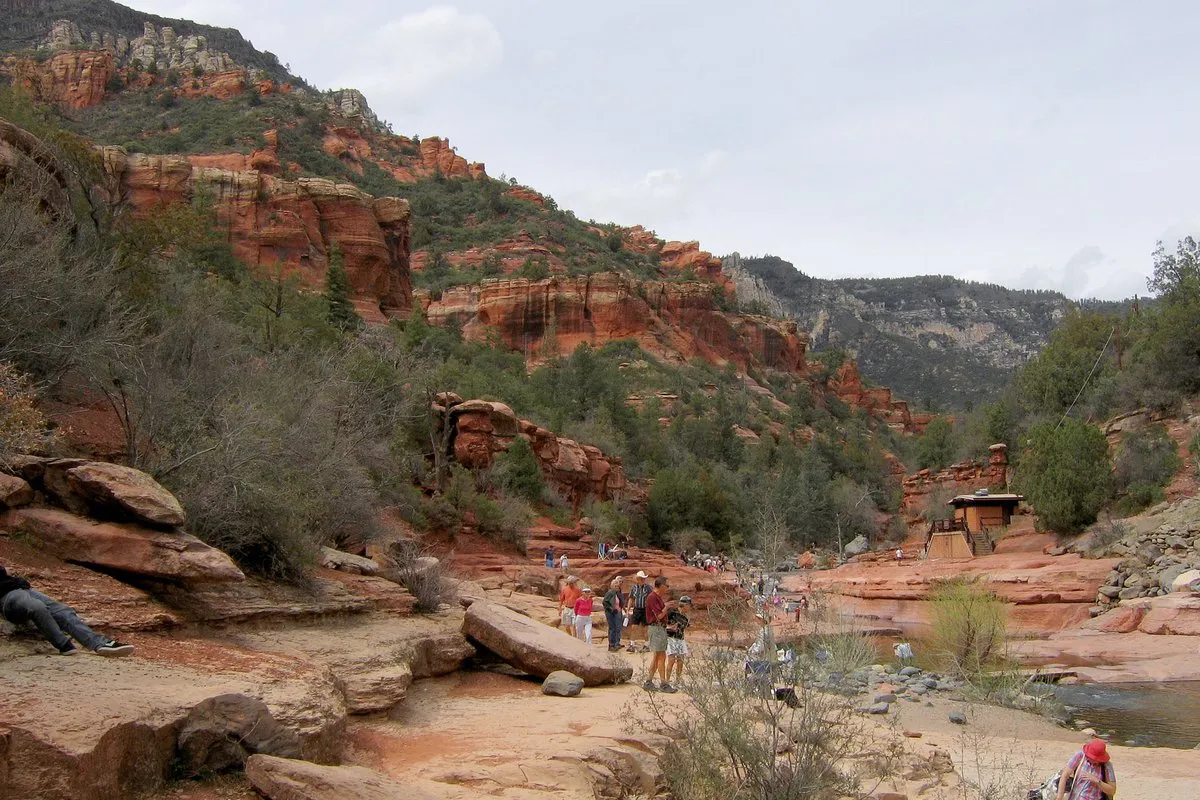
Slide Rock State Park sits in the heart of Oak Creek Canyon, about seven miles north of Sedona along Highway 89A. The park draws visitors from across the country for one reason above all others: a stretch of Oak Creek where smooth sandstone channels the water into a natural slide that drops swimmers downstream over slick red rock. Combine that with canyon walls glowing orange and rust in the afternoon light and the preserved remains of an early twentieth-century apple ranch, and you have one of Arizona’s most distinctive state parks.
The Natural Water Slide and Oak Creek Swimming
The slide itself is the centerpiece of everything here. Over thousands of years, Oak Creek carved a series of chutes through the Schnebly Hill Formation sandstone, creating a channel roughly eighty feet long and two and a half to four feet wide, with a seven percent decline that funnels swimmers at a respectable clip into a pool below. The experience is straightforward and genuinely fun, which explains why the parking lot fills quickly on busy spring and summer days.
The creek offers more than just the main slide. Visitors spread out along the banks to swim in the deeper pools, wade through shallower sections, and find their own patches of smooth rock to sun on between runs. Water temperatures stay cool even in July, fed by snowmelt and springs higher in the canyon. That coolness is part of the appeal in a region where summer air temperatures routinely exceed 100 degrees.
Water shoes are not optional here in any practical sense. The creek bottom and slide surface carry a layer of algae that makes bare feet on wet rock genuinely dangerous. Many visitors learn this the hard way. Closed-toe water shoes with rubber soles make the difference between an enjoyable day and a badly bruised visit.
Pendley Homestead and the Apple Orchard History
Frank L. Pendley arrived in Oak Creek Canyon in 1907 and formally acquired the land under the Homestead Act in 1910. He recognized that the canyon’s combination of reliable water, fertile soil, and moderate temperatures made it well suited for apple cultivation, and he built an irrigation system that is still visible and partially functional today. At its peak, the orchard covered several acres and shipped fruit across the region.
The Pendley Homestead house, tourist cabins, apple packing barn, and historic farm implements are available for viewing along the self-guided Pendley Homestead Trail. Interpretive signs explain how the irrigation flume worked and what daily life on a remote canyon homestead looked like in the early twentieth century. The orchard itself continues to produce apples, and the trees are particularly striking in fall when the fruit ripens against the red canyon backdrop. This history gives the park a layer that pure recreation areas lack, and it rewards visitors who take twenty minutes away from the creek to walk through it.
Hiking in the Canyon
The park is not primarily a hiking destination, but it does offer a few trails worth knowing about. The Pendley Homestead Trail is a short, easy paved loop that winds through the orchard and past the historic structures. The Slide Rock Route is a short but primitive path rated moderate that follows the creek corridor to the main swim area. The Clifftop Nature Trail is another short option near the apple barn, with views down over the swim area below.
For more serious hiking, the surrounding Coconino National Forest offers trailheads within a short drive. The park itself is compact enough that most people spend their time at the creek rather than on trails.
Pet Policy
Pets are not permitted in Slide Rock State Park from May 1 through September 30, and they are not allowed in the creek or swim area at any time of year. From October through April, pets are welcome in other parts of the park as long as they are kept on a leash and attended at all times. The seasonal restriction exists in part to protect water quality in a heavily used swimming area and in part to reduce stress on wildlife in the canyon corridor. Service animals are permitted in accordance with state policy.
Wildlife to Be Aware Of
Western diamondback rattlesnakes live throughout this part of Arizona, and Oak Creek Canyon provides ideal habitat. Rocky creek banks, brush along trail edges, and warm flat surfaces where snakes thermoregulate are all places to watch your step. Give any snake you encounter space and do not attempt to handle or move it. Most bites happen when people get too close.
Black bears are present in the Oak Creek Canyon corridor, and their activity increases in fall when the apple orchard produces ripe fruit. Bears in the area are not typically aggressive, but they are large wild animals and should never be approached. Store food securely, do not leave snacks unattended at the creek, and be alert on early morning or evening visits during harvest season.
Coyotes have been seen within the park and around Oak Creek Canyon. Like coyotes anywhere near heavy human use, they may grow bolder if people feed them or leave food unattended. Do not feed them under any circumstances. Feeding coyotes is the direct cause of the boldness that occasionally leads to conflicts.
The slippery algae on the creek’s rock surfaces is listed here alongside wildlife because it causes more injuries in this park than any animal does. Treat it as seriously as you would any other hazard.
Practical Information
Slide Rock State Park is located at 6871 N. Highway 89A, Sedona, Arizona, approximately seven miles north of Sedona proper. The drive up Oak Creek Canyon on Highway 89A is itself scenic and can be slow on busy summer weekends due to traffic.
Entry fees are $30 per vehicle from May through September for up to four people and $20 per vehicle from October through April. Additional passengers are charged $5 each, and children under six are free. Check azstateparks.com for current rate schedules before visiting.
The park reaches its daily capacity limit early on summer weekends and holidays. Aiming for the 8 a.m. opening significantly improves the odds of getting in during summer, but visitors may not line up along the driveway or highway before the park opens or when the lot is full. Day-use reservations are not available, and admission is by vehicle through the entry station only, with no walk-ins, drop-offs, or bicycle entries permitted.
Frequently Asked Questions
How much does it cost to enter Slide Rock State Park?
Entry is $30 per vehicle during peak season for up to 4 passengers, or $20 during non-peak season, with an additional $3 charged per passenger beyond four. Check azstateparks.com for current seasonal rates before your visit.
Are dogs allowed at Slide Rock State Park?
Pets are not permitted in the park from May 1 through September 30, and are never allowed in the creek or swim area; from October through April leashed pets are welcome in other areas of the park.
Do I need water shoes at Slide Rock State Park?
Water shoes are strongly advised, as the slide surface and creek bottom carry a layer of algae that makes bare feet on wet rock genuinely dangerous. Closed-toe water shoes with rubber soles are the recommended footwear for a safe visit.
What wildlife might I encounter at Slide Rock State Park?
Visitors may encounter western diamondback rattlesnakes along rocky creek banks and trailside brush, coyotes near the park perimeter and parking areas, and black bears in the Oak Creek Canyon corridor, particularly near the apple orchards in fall. Feeding wildlife is not permitted.