
Elephant Rocks State Park
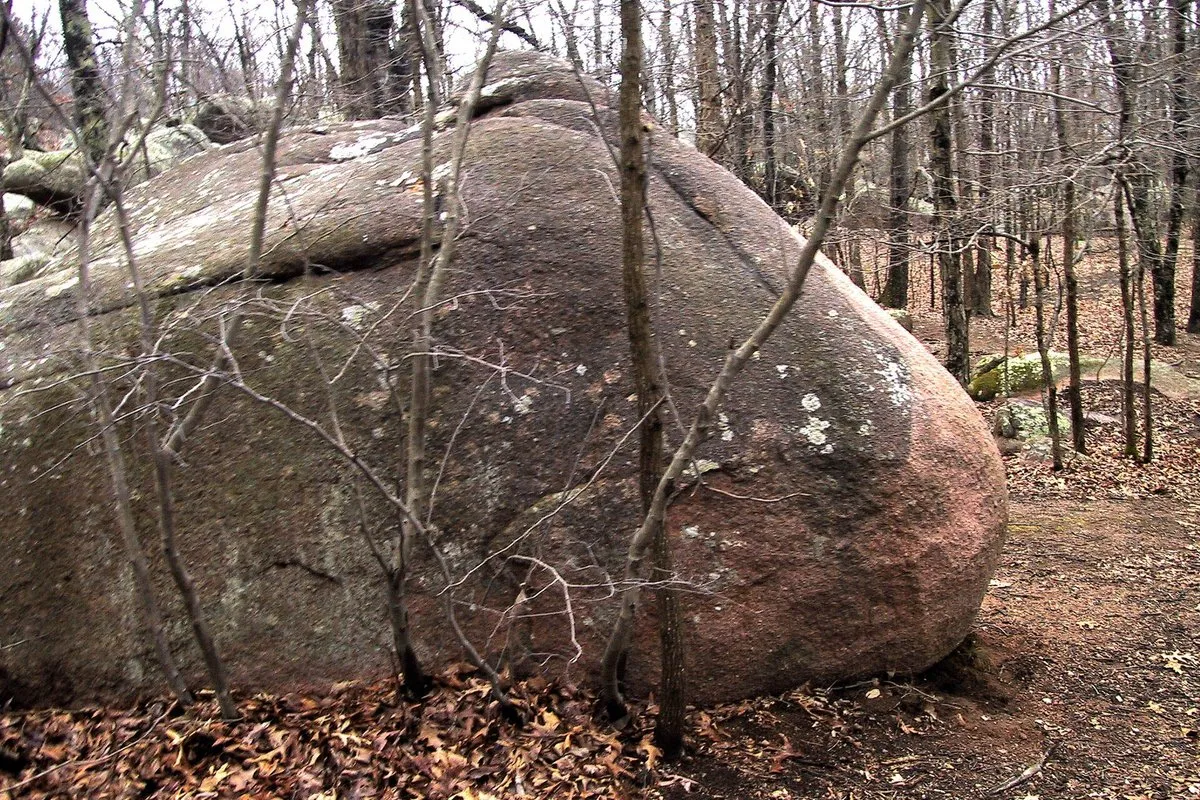
Elephant Rocks State Park protects one of the most visually striking geological formations in Missouri: a chain of enormous pink and red granite boulders, some reaching 27 feet tall and weighing up to 680 tons, arranged along a natural ridgeline in the St. Francois Mountains. Located in Iron County in southeastern Missouri, the park draws geology enthusiasts, families, and curious visitors who want to walk among rock formations that predate most life on Earth. The granite here is approximately 1.4 billion years old, making it some of the oldest exposed rock in the United States and a genuine window into the deep history of the continent.
The Granite Giants and What Shaped Them
The boulders that give the park its name were not deposited here. They formed in place as molten rock cooled slowly underground, then became exposed over millions of years as softer surrounding rock eroded away. Weathering carved the granite into rounded forms through a process called spheroidal weathering, where water infiltrates natural joints in the rock and gradually rounds the corners and edges over vast stretches of time. The result is a train-like line of massive rounded boulders that gave early settlers the impression of a herd of elephants walking single file. Standing among them gives a clear sense of scale that photographs rarely capture. Some boulders are named, including Dumbo, Horatio, and Fat Man, with the latter featuring a narrow crevice that park visitors have squeezed through for generations.
The Braille Trail and Accessible Exploration
The park’s main walking route is the 0.9-mile Elephant Rocks Braille Trail, a paved and accessible loop that winds through and around the boulder formations. It is one of Missouri’s older accessible trails and was designed so that visitors with visual impairments could navigate it using a guide rope, with interpretive signs available in Braille. The trail passes directly alongside and between the largest boulders, giving every visitor a close look at the granite’s texture, the lichen and moss colonizing its surface, and the dramatic scale of the formations. The paved surface makes it manageable for strollers and wheelchairs, though some sections follow the natural rise and fall of the terrain. Additional unpaved areas around the rocks allow for informal exploration beyond the trail corridor, though visitors should watch footing carefully on uneven rock surfaces.
Quarrying History
The granite at Elephant Rocks was commercially quarried in the late 1800s, and evidence of that work is visible throughout the park. Visitors can see drill holes, cut faces, and the remains of a stone engine house used during active quarrying operations. The St. Francois County granite was prized for its hardness and appearance, and stone from this area was used in construction projects across the region, including curbing, paving blocks, and building foundations. Interpretive signage along the Braille Trail explains the quarrying process and points out specific features left behind. The combination of industrial history layered onto ancient geology makes the site more textured than a typical scenic overlook.
Picnicking and Day Use
The park is designed primarily for day visits. A shaded picnic area with tables and restroom facilities sits near the trailhead and parking area. The setting among oak and hickory forest, with the granite outcrops rising above the tree canopy in places, makes it a comfortable spot for a midday break. There is no camping at Elephant Rocks, and no water recreation. The park is a focused destination, worth a half-day visit combined with nearby Johnson’s Shut-Ins State Park, which is roughly 12 miles to the south.
Pet Policy
Pets are welcome at Elephant Rocks State Park and must be kept on a leash no longer than 10 feet at all times. Pets are allowed on the Braille Trail and in picnic areas. Owners are responsible for cleaning up after their animals. Given the rocky terrain and crevice-heavy environment, keep dogs close and away from gaps in the rock where wildlife may shelter.
Wildlife to Be Aware Of
The rocky outcrops, crevices, and boulder gaps at Elephant Rocks create ideal habitat for venomous snakes, and visitors should move through the park with that in mind. The Eastern Copperhead is the most likely species to encounter. Copperheads favor exactly the kind of environment found here: shaded rocky areas, leaf litter near boulders, and crevices that hold warmth. They are active from mid-March through November and are well camouflaged against granite and fallen leaves. Avoid reaching into crevices, stepping over rocks without looking at the landing side, or sitting on boulders without checking first. The Timber Rattlesnake is also possible in this terrain, though less commonly seen. Rattlesnakes in the Ozarks tend to use rocky slopes and outcrops as basking and sheltering sites. They will generally avoid confrontation if given the opportunity, but a surprised snake in a confined rocky space is a real hazard. Wear closed-toe shoes, watch where you place your hands and feet, and give any snake you encounter space to move away.
Practical Information
Elephant Rocks State Park is located at 7406 Highway 21 in Belleview, Missouri, approximately 90 miles south of St. Louis. The nearest town with services is Ironton, about 8 miles to the southeast. Highway 21 provides direct access, and the park entrance is clearly marked. There is no entry fee. Missouri State Parks do not charge general admission, though some amenities at other parks may carry fees. No reservations are required for day use. The park is open year-round, with seasonal hours that vary, so check the official website before visiting. Winter visits are possible on dry days, but wet or icy conditions make the granite surfaces slippery and dangerous.
Frequently Asked Questions
Is there an entry fee for Elephant Rocks State Park?
Elephant Rocks State Park is free to visit, as Missouri State Parks do not charge general admission, though some individual amenities may have fees.
Are dogs allowed at Elephant Rocks State Park?
Pets are welcome and must be kept on a leash no longer than 10 feet at all times. Leashed dogs are allowed on the Braille Trail and in picnic areas.
Is the trail at Elephant Rocks State Park wheelchair accessible?
The one-mile Elephant Rocks Braille Trail is a paved, accessible loop designed for visitors with visual and physical disabilities, and its paved surface also accommodates strollers and wheelchairs, though some sections follow the natural rise and fall of the terrain.
Are there snakes at Elephant Rocks State Park?
Visitors should be aware that Eastern Copperheads are present in the park's rocky outcrops and crevices and are active from mid-March through November, and Timber Rattlesnakes are also possible in the rocky Ozark terrain, so care should be taken when stepping on uneven rock surfaces or placing hands in crevices.