
Humboldt Redwoods State Park
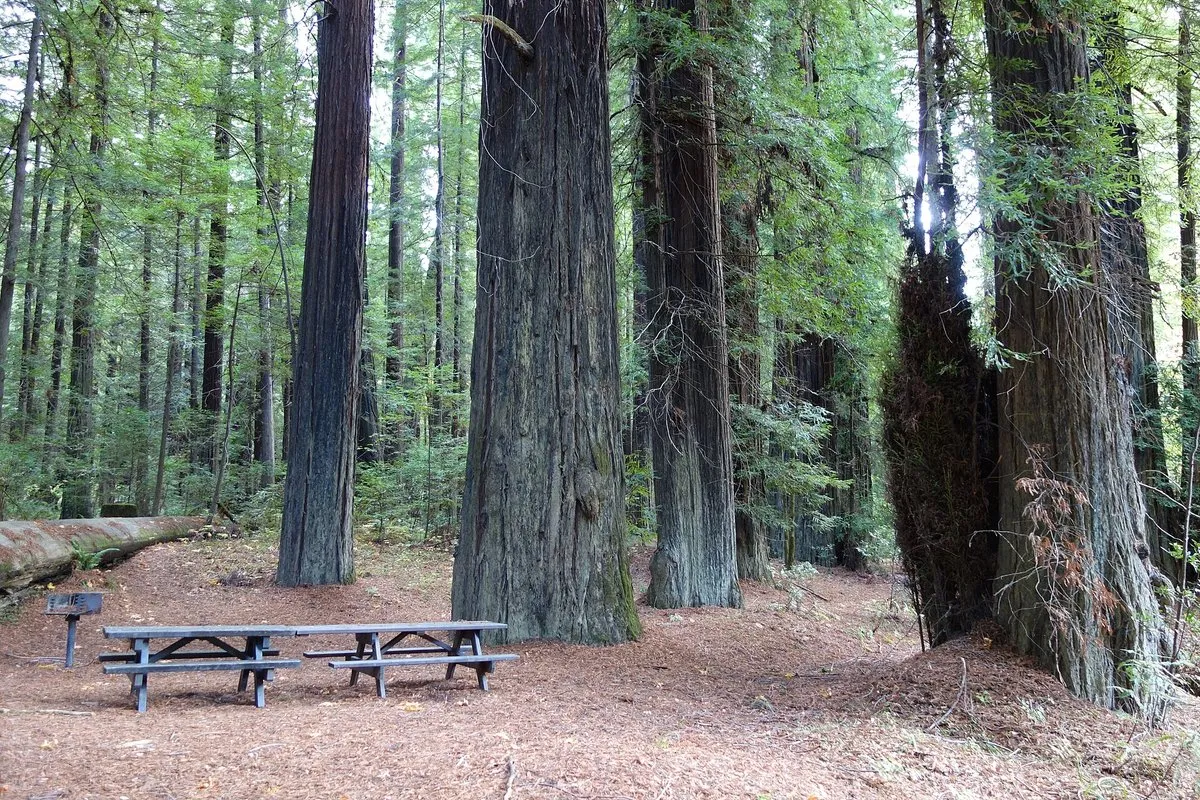
Humboldt Redwoods State Park protects the largest remaining old-growth coast redwood forest on Earth, covering more than 53,000 acres in Humboldt County along California’s North Coast. The park runs through the valley of the South Fork Eel River, where ancient trees rise hundreds of feet above a quiet, fern-lined forest floor. These trees are among the tallest living things on the planet. The scale of the forest registers differently once you’re inside it rather than reading about it.
The Avenue of the Giants and Scenic Driving
Running parallel to Highway 101 for roughly 32 miles, the Avenue of the Giants is one of the most celebrated scenic drives in the American West. The two-lane road passes through dense groves of old-growth redwood, with pull-outs offering access to short walks and towering trees overhead. Several named groves line the route, including Founders Grove and Rockefeller Forest, the latter considered the largest old-growth redwood forest in the world. Even a slow drive through the avenue takes the better part of an afternoon if you stop frequently, which you should.
Hiking and Old-Growth Groves
The park has more than 100 miles of trails ranging from flat, accessible paths to strenuous ridge hikes. Rockefeller Forest alone offers several loop options through cathedral-like old growth, and the Bull Creek Flats Trail provides a gentle walk along the creek through some of the most impressive trees in the park. For a longer challenge, the Grasshopper Peak Trail climbs to a fire lookout with views across the forest canopy. Many trails connect to one another, so hikers can design routes of varying lengths. Spring and early summer bring abundant wildflowers to the forest understory, and the filtered light through the canopy is especially striking on foggy mornings.
Camping
The park has three developed family campgrounds: Burlington, Hidden Springs, and Albee Creek, plus Cuneo Creek Horse Camp for equestrians. Burlington sits closest to the visitor center and is open year-round, making it a reliable base for exploring the park in any season. Albee Creek, set in second-growth redwoods and open meadows near Rockefeller Forest, offers a quieter alternative and has 40 family sites. Most campgrounds include restrooms with showers, fire rings, and picnic tables. Reservations are strongly recommended from late spring through early fall, as sites fill quickly on weekends. During slower periods, a limited number of unreserved sites are available on a first-come, one-night-at-a-time basis.
Pet Policy
Pets are welcome in the park but must be kept on a leash no longer than six feet at all times. Dogs are allowed only in developed areas such as campgrounds, paved roads, and parking areas, and except for service animals they are not permitted on park trails. This restriction exists in part to protect the sensitive forest environment and wildlife. Pets must not be left unattended at campsites, and owners are expected to clean up after them. If you plan to visit with a dog, stick to developed areas and check current access information before you go, as posted rules and temporary closures can change.
Practical Information
Humboldt Redwoods State Park is located along Highway 101 between the towns of Garberville and Fortuna in Humboldt County. The main visitor center is at Burlington, accessible via the Avenue of the Giants exit near Weott. The nearest town with full services is Garberville, about 20 miles to the south. There is no entrance fee for the park, and most day-use areas are free to access. Williams Grove Day Use Area charges $8 per vehicle. Camping fees apply per site per night at the developed campgrounds. Annual California State Parks passes are accepted. The park is open year-round, though winter rains can cause flooding along Bull Creek and some road closures. Fog is common in summer mornings but typically burns off by midday. Cell service is limited throughout the park.
Wildlife to Be Aware Of
Black bears are present in Humboldt Redwoods and are the primary wildlife concern for campers. Store all food, trash, and scented items in bear boxes provided at campgrounds or in a hard-sided locked container in your vehicle. Never leave food at a campsite unattended, and do not bring food into tents. If a bear visits camp, make noise to drive it off without approaching. Mountain lions inhabit the park’s forested terrain. Encounters are rare, but the old-growth forest provides good cover. Make noise on trails, keep children within sight, and do not hike alone in remote areas. If you encounter a mountain lion, do not run; make yourself appear large and back away slowly. Poison oak is widespread throughout the lower elevations of the park and is especially common along stream corridors and lower trail sections. Learn to recognize it by its three-leaflet clusters, shiny surface, and red tones in spring and fall. Contact causes a delayed allergic rash that can be severe. Wash exposed skin and clothing thoroughly after any off-trail travel. Ticks are present in brushy and grassy areas; use insect repellent and check carefully after any time in dense vegetation.
Frequently Asked Questions
Is there an entry fee for Humboldt Redwoods State Park?
Most areas of the park are free to enter, though the Williams Grove Day Use Area charges $8 per vehicle and camping fees apply per site.
Are dogs allowed at Humboldt Redwoods State Park?
Pets must be kept on a leash no longer than six feet at all times and are restricted to developed areas such as campgrounds, paved roads, and parking lots. Dogs are not permitted on park trails, except for service animals.
What is the Avenue of the Giants and how long does it take to drive?
The Avenue of the Giants is a 32-mile scenic road running parallel to Highway 101 through dense old-growth redwood groves, and a slow drive with frequent stops takes the better part of an afternoon.
Are there bears at Humboldt Redwoods State Park?
Black bears are present in the park, and campers are required to store food in bear boxes or hard-sided containers at campgrounds.