
Devil's Lake State Park
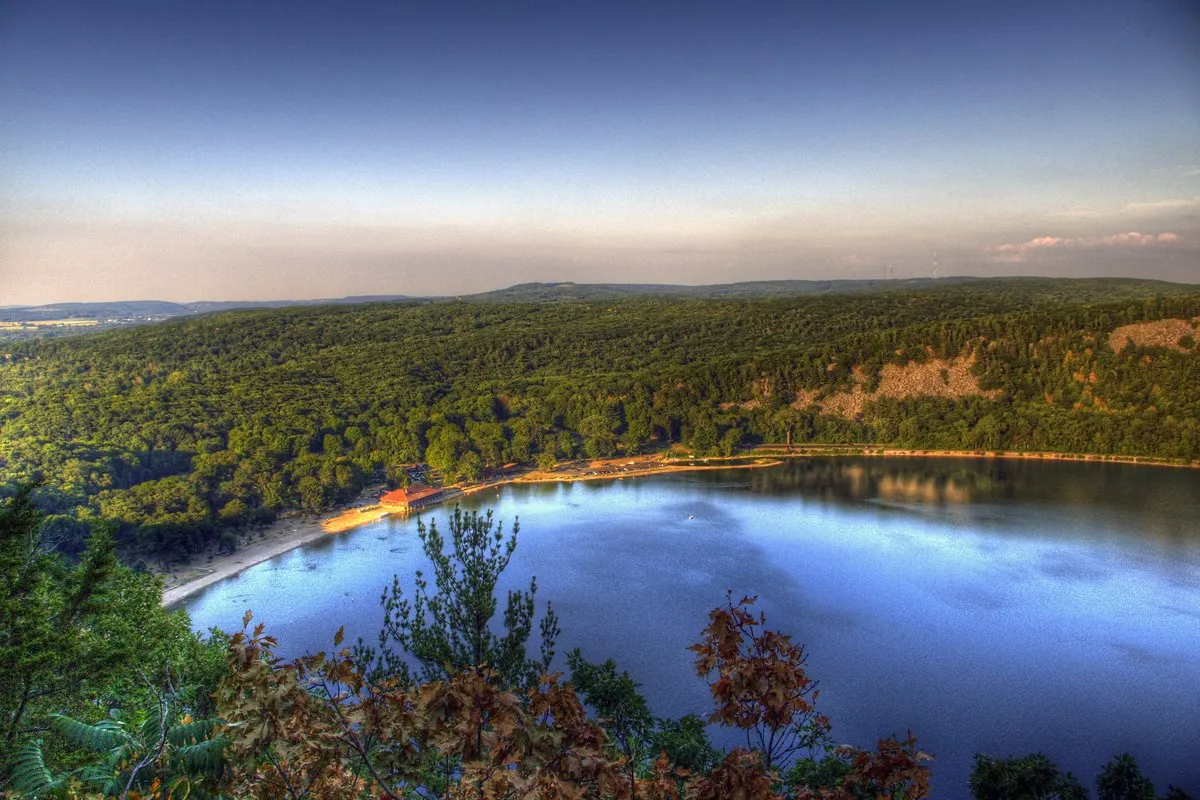
Wisconsin’s most-visited state park draws more than 2.5 million visitors a year to a glacial landscape unlike anything else in the region. Devil’s Lake sits in a narrow gorge along the Baraboo Range, where ancient quartzite bluffs rise 500 feet above a clear spring-fed lake with a small surface inlet but no natural outlet. The result is an unusually dramatic combination of rock, water, and forest packed into a relatively compact area in Sauk County, about an hour northwest of Madison.
The Bluffs and Their Climbing Routes
The quartzite bluffs are the defining feature of the park and the main reason dedicated visitors return year after year. Rock climbers have worked these walls for decades, and the south and east bluffs in particular host hundreds of established routes ranging from beginner slabs to serious multi-pitch faces. The rock is coarse and grippy, and the exposure at the top provides views across the Baraboo River valley that reward even those who hike rather than climb. The Wisconsin Department of Natural Resources asks climbers to follow any posted closures and restrictions. Bouldering is also popular in the talus fields at the base of the bluffs, where freeze-thaw-broken quartzite blocks of every size create a natural playground.
29 Miles of Hiking Trails
Trails here range from a flat lakeside path to steep ridge routes that gain elevation quickly. The East Bluff Trail and West Bluff Trail each offer sustained ridge walking with open views, and both can be combined with connector trails into longer loop routes. The Grottos Trail on the east side passes through a jumbled field of enormous boulders that feel genuinely ancient. For families or visitors who want a gentler outing, the lakeside and day-use paths stay close to the water and require little elevation gain. Trail surfaces vary considerably; the bluff routes involve rocky scrambling in places and are not suitable for strollers or people with limited mobility.
The Lake and Beach Areas
The lake itself covers about 360 acres and is the focal point of the park’s recreational infrastructure. Two sandy beach areas sit at the north and south ends of the lake, with restroom facilities available in season. Swimming is excellent, with clear water and a sandy bottom. Kayaks, stand-up paddleboards, and paddleboats can be rented at the concession areas, and privately owned nonmotorized watercraft and boats with electric motors may be used. Fishing for bass, northern pike, and panfish is popular throughout the warm months. No motorized boats beyond electric motors are permitted, which keeps the lake quiet enough that paddling feels genuinely peaceful even on busy weekends.
Camping
The park operates three regular campgrounds with a combined capacity of several hundred sites, covering tent camping, electrical hookups, and a group camp area. Quartzite campground is closest to the lakeshore. Reservations are required and are especially important from Memorial Day through Labor Day; bookings can be made through the Wisconsin state park reservation system up to eleven months in advance. Shower buildings are available for registered campers. The campgrounds stay open into the fall, and Quartzite campground is open year-round, which makes fall one of the best times to visit given the foliage color on the bluffs and the reduced crowds.
Pet Policy
Leashed pets are welcome in most areas of the park, including trails and campgrounds. The leash must be no longer than eight feet. Pets are not allowed on the regular swim beaches or in the designated human swim areas of the lake, though the park does have designated pet swim areas. Owners are expected to clean up after their animals and dispose of waste properly.
Wildlife to Be Aware Of
The rocky bluffs and talus slopes of the south and east sides of the park are home to timber rattlesnakes, one of Wisconsin’s two venomous snake species. These snakes are not aggressive but will defend themselves if cornered or stepped on. When hiking on rocky terrain or scrambling through boulder fields, watch where you place your hands and feet. Wearing sturdy boots provides meaningful protection. Give any rattlesnake you encounter plenty of space and move away calmly.
The eastern massasauga is Wisconsin’s other venomous snake, but timber rattlesnakes are what visitors at Devil’s Lake are most likely to encounter. The same precautions apply: stay alert on rocky ground, do not reach into crevices or under rocks, and treat any unfamiliar snake as potentially venomous until you know otherwise.
Black bears are uncommon this far south in Wisconsin but can occasionally pass through the Baraboo Hills and have been reported in the broader area. Bears in this area are generally not habituated to humans, but food storage still matters. Keep food secured in your vehicle or a hard-sided cooler when camping, and do not leave anything scented unattended at a campsite. If you see a bear, give it space and do not approach.
Practical Information
Devil’s Lake State Park is located near Baraboo, Wisconsin, at coordinates 43.4233, -89.7318. From Madison, take US-12 northwest toward Baraboo, then follow signs to County Highway DL for the north shore or South Lake Road for the south shore. From the north, US-12 through Baraboo connects directly to park access roads.
Daily vehicle admission is $13 for vehicles with Wisconsin plates and $16 for vehicles with out-of-state plates. A 12-month state park vehicle admission pass costs $28 for Wisconsin plates and $50 for out-of-state plates. Pedestrians and cyclists enter free.
The park is open year-round, though some facilities including beach rentals and concessions operate seasonally, with rentals generally available during summer. Fall hiking is excellent and significantly less crowded than summer. Winter visitors use the trails for snowshoeing and ungroomed cross-country skiing when conditions allow.
Frequently Asked Questions
How much does it cost to enter Devil's Lake State Park?
A daily vehicle pass costs $8 for Wisconsin residents and $11 for non-residents, while an annual sticker runs $28 for residents and $38 for non-residents. Pedestrians and cyclists enter free of charge.
Are dogs allowed at Devil's Lake State Park?
Leashed pets are welcome on trails and in campgrounds throughout most of the park, provided the leash is no longer than eight feet.
Are there venomous snakes at Devil's Lake State Park?
Timber rattlesnakes are present on the rocky bluffs and talus slopes, particularly on the south and east bluffs, and copperhead snakes are rarely encountered in the same talus areas near the bluffs. Visitors should watch their step carefully when hiking or bouldering in those zones.
How early do the parking lots fill up at Devil's Lake on summer weekends?
The parking lots at both the north and south shore tend to fill early on summer weekends and holidays, often by mid-morning, so arriving early is strongly recommended.