
Cheesequake State Park
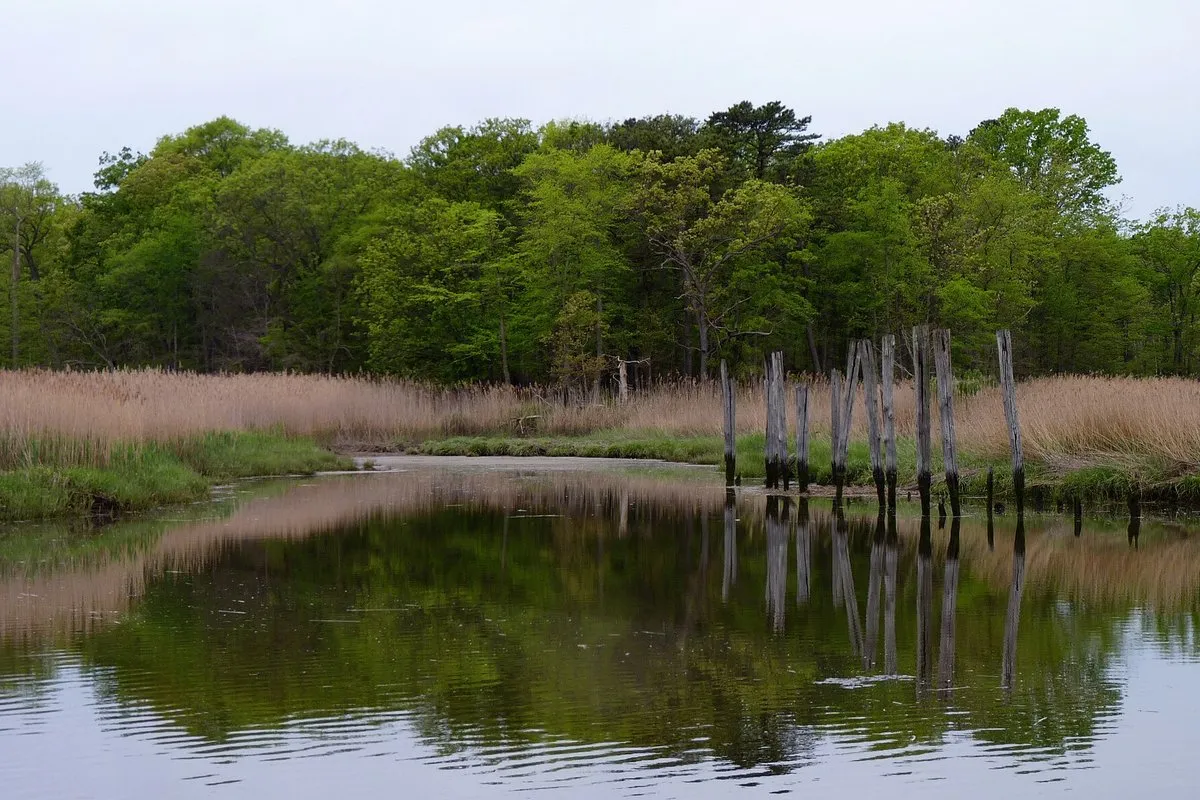
Cheesequake State Park occupies a stretch of central New Jersey where several distinct ecosystems converge in a way that is genuinely unusual for the mid-Atlantic region. Located in Middlesex County near the town of Matawan, the park sits at a natural boundary where the ecology of the Pine Barrens meets hardwood forest, cedar swamps, and tidal salt marsh. That overlap makes it one of the more ecologically complex state parks in New Jersey, drawing both casual visitors and people with a serious interest in natural history.
Where Ecosystems Collide: The Park’s Ecological Identity
The defining characteristic of Cheesequake is the transition zone at its core. Within a few hundred yards, you can move from an open salt marsh fed by tidal creeks to a dense Atlantic white cedar swamp, then uphill into a mixed hardwood forest, and farther into vegetation that would look at home in the Pine Barrens to the south. This kind of ecological layering is rare this far north along the Eastern Seaboard. The park protects roughly 1,600 acres, and the variety packed into that space rewards repeated visits across different seasons. Spring brings migrating birds in quantity. Fall shifts the hardwood canopy through its full range of color while the marshes stay green longer. Even winter visits offer clear sightlines into the swamp interiors that summer growth obscures.
Trails Through the Transition Zone
Five marked trails cover the park’s major terrain types, ranging from short loop walks to longer routes that cross through multiple habitat zones. The Green Trail is the longest option at around three miles and passes through the most varied terrain, moving through upland forest, along wetland edges, and through the park’s largest Atlantic white cedar swamp. The Yellow Trail is a shorter loop that touches the edges of the salt marsh and Hooks Creek Lake. Boardwalk and step sections help in the soggiest spots. The trails are well-maintained but not heavily engineered, so expect muddy conditions after rain, especially in low-lying sections near the swamp and marsh. Trail maps are available at the park office near the main entrance.
Hooks Creek Lake and Swimming
The park’s freshwater swimming area sits on Hooks Creek Lake, which is the primary draw for families during summer. A sand beach, a guarded swim area, changing facilities, and a concession stand make this a functional day-use destination from Memorial Day weekend through Labor Day, weather and staffing permitting. The lake also supports fishing, and anglers work the shoreline and launch cartop boats, kayaks, canoes, and paddleboards from the access area, with electric motors permitted. There is no rental service on site.
Camping at Cheesequake
The campground offers around 53 sites and accepts both tent camping and RVs. Sites are set in a wooded area away from the day-use facilities, and the campground stays open from spring through late fall. There are no water or electric hookups, generators are not permitted in the campsites, and RVs are subject to an 11-foot height restriction at the campground entrance. Reservations are strongly recommended for summer weekends, as the campground fills quickly given its proximity to the New York metropolitan area. The park sits close enough to the Garden State Parkway that it serves as a convenient base for people traveling through the region, though its own trails and natural features make longer stays worthwhile on their own terms.
Pet Policy
Pets are welcome in most day-use areas of the park, including on trails, and in designated pet-friendly campsites, and must be kept on a leash no longer than six feet at all times. Pets are not permitted in the swimming area or on the guarded beach. Owners are expected to clean up after their animals throughout the park. Bringing a pet to the campground requires registration, proof of rabies vaccination, and an additional fee.
Wildlife to Be Aware Of
Ticks are present throughout Cheesequake year-round and are most active from spring through fall. The combination of forested areas, tall grass, and marshy edges creates ideal habitat for both deer ticks and dog ticks. Check yourself, your children, and any pets thoroughly after any time on the trails or in brushy areas. Wear long pants and closed shoes when hiking, and consider treating clothing with permethrin before visits.
Copperhead snakes are not a concern at Cheesequake. New Jersey does have venomous snakes, but copperheads are limited to hilly, forested areas farther north and west of the park. Whatever the species, give any snake you encounter space, watch where you step, and avoid placing your hands into leaf litter, brush, or rock crevices where you cannot see clearly.
Mosquitoes can be intense near the freshwater swamp and salt marsh areas, particularly at dawn and dusk. A repellent with DEET or picaridin is worth carrying on any trail that passes through low-lying or marshy terrain.
Practical Information
Cheesequake State Park is located at 300 Gordon Road, Matawan, New Jersey. The main entrance is accessible from the Garden State Parkway at Exit 120. The nearest town with services is Matawan, a short drive from the park entrance.
Entry fees apply from Memorial Day weekend through Labor Day. New Jersey residents pay $5 per vehicle on weekdays and $10 per vehicle on weekends and holidays. Out-of-state vehicles are charged higher rates. Pedestrians and cyclists enter free. Camping fees are separate from the day-use entry fee, and reservations for campsites can be made through the New Jersey State Park Service reservation system. The park office can be reached by phone for current conditions and availability.
Frequently Asked Questions
Are dogs allowed at Cheesequake State Park?
Pets are welcome on trails and in the campground but must be kept on a leash no longer than six feet at all times. Pets are not permitted in the swimming area at Hooks Creek Lake.
How much does it cost to enter Cheesequake State Park?
Entry is $7 per vehicle on weekdays and $10 on weekends and holidays for in-state vehicles, with higher rates for out-of-state vehicles, and fees apply from Memorial Day weekend through Labor Day. Pedestrians and cyclists enter free of charge.
Are there snakes or ticks at Cheesequake State Park?
Ticks are present year-round throughout the forested and marshy areas of the park, with peak activity from spring through fall, so checking yourself after any trail visit is strongly advised. Copperhead snakes also inhabit rocky and wooded edges near wetlands, so hikers should use caution along trails in those areas.
Can you swim at Cheesequake State Park?
Swimming is available at the sand beach on Hooks Creek Lake, which is staffed by lifeguards and open from late June through Labor Day. Changing facilities and a concession stand are located at the lake, and swimming is only permitted in the designated guarded area.