
Sleeping Giant State Park
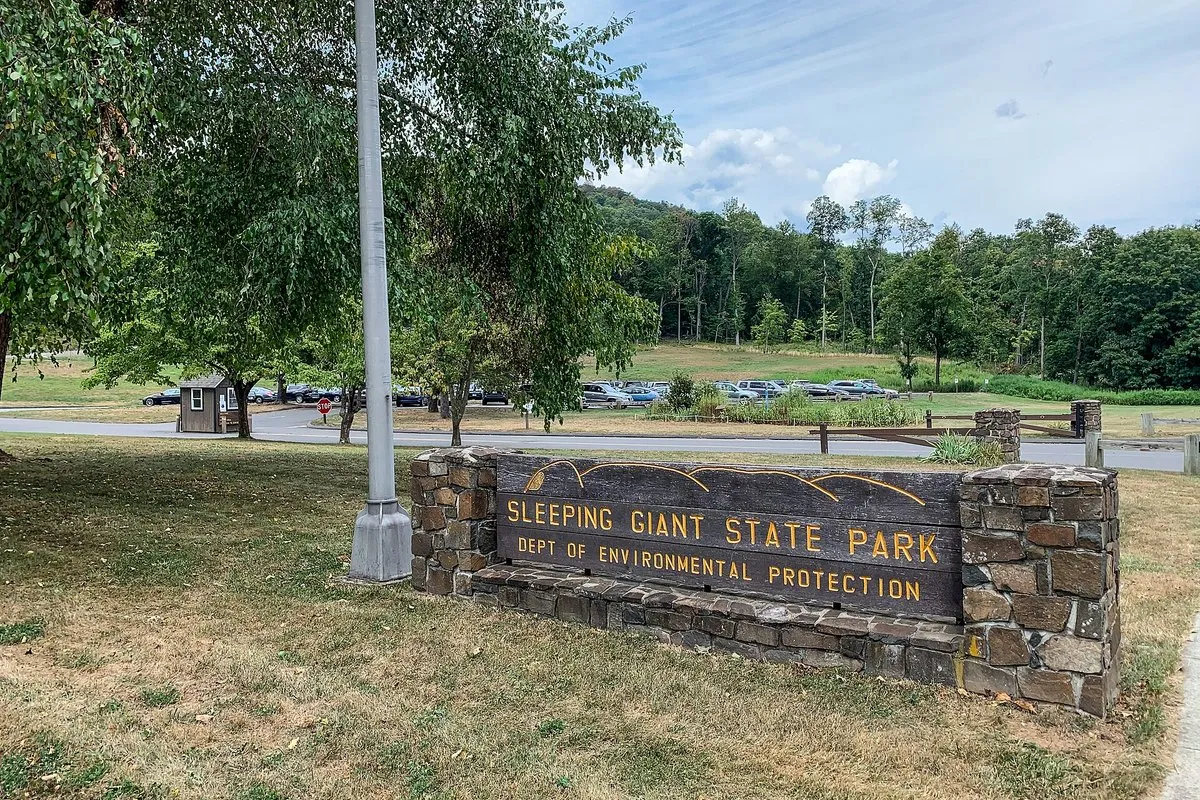
Sleeping Giant State Park rises above the suburban landscape of Hamden, Connecticut, its long traprock ridge forming a silhouette that genuinely resembles a reclining human figure when viewed from a distance. The park covers approximately 1,439 acres across the southern end of the Mount Carmel section of Hamden, and its defining feature, the ridge itself, draws hikers, history enthusiasts, and casual visitors from across southern New England. What sets it apart from other Connecticut state parks is the combination of serious hiking terrain, a hand-built stone observation tower at the summit, and a trail network dense enough to support dozens of different route combinations within a relatively compact area.
The Tower Trail and Summit Experience
The park is best known for its Tower Trail, a wide, well-marked path that climbs to the stone observation tower at the top of the Giant’s head. The tower was constructed in 1936 by the Works Progress Administration, and it remains one of the more satisfying summit destinations in Connecticut. On clear days, the views stretch south toward New Haven Harbor and Long Island Sound. The climb is moderate, gaining approximately 600 feet over about 1.6 miles, and the trail is accessible to most hikers with reasonable fitness. The tower is open during daylight hours and requires a short climb up interior stairs to reach the top platform.
Over 30 Miles of Trails for Every Level
Beyond the Tower Trail, the park offers over 30 miles of marked hiking trails organized around a color-coded system. The network covers the full length of the ridge as well as the lower slopes and ravines, offering routes from short loop walks under a mile to full ridge traversals of several miles. The blue-blazed Quinnipiac Trail runs through the park for 4.75 miles and connects to a longer 23-mile regional trail corridor. Hikers looking for more rugged terrain can follow the rocky spine of the ridge along the red trail, which involves some scrambling and offers exposed views at multiple points. The trail system is maintained collaboratively by the Sleeping Giant Park Association and the State of Connecticut, and paper trail maps are available at the main trailhead kiosk near the parking area on Mount Carmel Avenue.
Picnicking, the Pond, and Non-Hiking Recreation
A small pond near the park entrance is used for fishing, and a picnic area nearby makes this section of the park a practical destination for families not planning to hike the full ridge. Grills and picnic tables are available on a first-come basis. Swimming is not permitted in the pond. The lower trailhead area near the picnic grounds serves as a natural gathering point on busy weekend mornings, so arriving early on summer and fall weekends is advisable if you want to secure a parking space or a picnic table.
Pet Policy
Dogs are welcome throughout Sleeping Giant State Park and must be kept on a leash no longer than seven feet at all times. Owners are responsible for cleaning up after their animals. Pets are not permitted in any designated swimming areas, though the absence of swimming at this park makes that restriction largely theoretical here. The trail network is generally well-suited to dogs, though rocky sections of the ridge trail can be hard on paws, especially in warmer months.
Wildlife to Be Aware Of
Black bears are present throughout the park and are seen with some regularity near trails and in the wooded interior. If you encounter a bear, do not approach it, make noise to alert it to your presence, and back away slowly. Bears are not typically aggressive, but feeding them intentionally or leaving food accessible is both illegal and dangerous. Bobcats inhabit the park as well and are occasionally spotted on quieter trails, particularly in the early morning or at dusk. They are elusive and not a significant threat to adults, but small children and pets should be kept close.
White-tailed deer are abundant and are frequently seen near trailheads and along the park access road. Use extra caution when driving to and from the park, particularly around dawn and dusk when deer are most active and crossings are unpredictable.
Deer ticks are a serious and persistent concern at Sleeping Giant. The park’s mix of wooded trails, leaf litter, and brushy edges creates ideal tick habitat throughout the warmer months, though ticks can be active any time temperatures rise above freezing. Lyme disease transmission is a genuine risk here. Wear long pants tucked into socks, use insect repellent containing DEET or permethrin on clothing, and do a thorough full-body tick check after every visit. Check children and pets carefully as well.
Practical Information
Sleeping Giant State Park is located at 200 Mount Carmel Avenue in Hamden, Connecticut (coordinates 41.4198, -72.9012), approximately four miles north of downtown Hamden and accessible from Route 10. The main parking area is just inside the park entrance off Mount Carmel Avenue. The park is open year-round from 8 a.m. to sunset.
Parking is free for Connecticut-registered vehicles. Out-of-state vehicles are charged a parking fee during peak season, payable online in advance or on-site at the parking area. There are no camping facilities at Sleeping Giant. Restrooms are available near the main parking area. No reservations are required for day use. Fall weekends bring heavy trail traffic due to foliage, and the Tower Trail in particular can become crowded by mid-morning on Saturdays and Sundays in October.
Frequently Asked Questions
Is there an entry fee for Sleeping Giant State Park?
Connecticut-registered vehicles enter free year-round through the Passport to the Parks program, while out-of-state vehicles are charged a fee from April 1 through October 31, payable online or on-site.
Are dogs allowed on the trails at Sleeping Giant State Park?
Dogs are welcome throughout the park and must be kept on a leash no longer than seven feet at all times, and owners are responsible for cleaning up after their animals.
Is the stone observation tower at the summit open to visitors?
The tower, built in the 1930s by the Sleeping Giant Park Association and the Civilian Conservation Corps, is open during daylight hours and requires a short climb up interior stairs to reach the top platform with views toward New Haven Harbor and Long Island Sound.
Are there black bears in Sleeping Giant State Park?
Black bears are present throughout the park and are seen with some regularity near trails and in the wooded interior, so visitors should make noise on the trail and never approach a bear if one is encountered.